This article may contain affiliate links. If you book or buy through these links, we may earn a commission at no extra cost to you. This does not affect our recommendations.
Last fact-checked August 2026. Opening hours and prices change — check on the day before you plan around any single shop.
Most people eat one thing in Nara: whatever is closest to the deer.
They arrive around eleven, walk to Todai-ji, buy something from a stand, and are back on a train to Kyoto or Osaka by four. Ask them afterwards what Nara food is like and they will not have an answer, because they never really ate here.
I live in Nara, so let me be blunt about the thing that causes this. Visitors assume there is nowhere to eat — that Nara is a park with a temple attached, and that dinner means leaving. That assumption stopped being true years ago, and almost every guide is still repeating it.
Nara has its own MICHELIN Guide edition. The 2026 selection lists 78 restaurants: four with two stars, 18 with one star, 11 Bib Gourmand, 45 Selected and seven Green Star. That is not a town you leave before dinner.
And at the other end of the scale, the streets in front of Kintetsu Nara Station now have the same chain restaurants and ramen shops that people here use on an ordinary weeknight. Not tourist cafes. The places you go on a Tuesday.
So this is a guide to both ends of that: the six things genuinely worth your stomach space, and where to actually find them.
- The Six Things Worth Your Stomach Space
- Where to Eat: Higashimuki, Mochiidono and Naramachi
- The Sake Part Nobody Tells You
- Nara at the Top End: What the MICHELIN Guide Actually Says
- How to Order When There Is No English Menu
- Where to Stay If You Are Here for the Food
- Fitting Nara Food Into an Actual Trip
- Nara Food FAQ
The Six Things Worth Your Stomach Space
Nara’s food is older and quieter than Osaka’s. There is no equivalent of takoyaki here — nothing loud you eat standing up in a crowd. What Nara has instead is a set of foods that exist for a reason, usually because this was a landlocked capital that had to solve a problem.
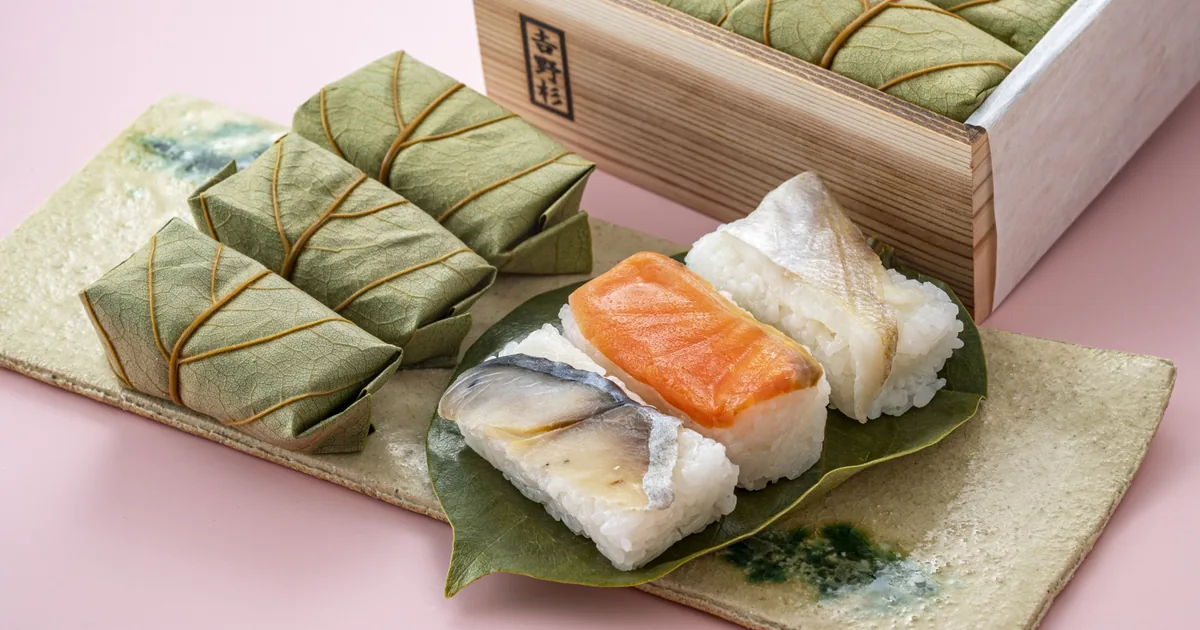
1. Kakinoha-zushi — the one with a reason behind it
Vinegared rice topped with salted mackerel or salmon, wrapped in a persimmon leaf.
The leaf is the point. Nara is inland, with no coast and, historically, no fast way to move fish. Persimmon leaves are rich in tannins, which slow bacteria down — so wrapping salted fish in them let the sushi keep for days. The technique is around 300 years old, and it was a preservation method long before it was a delicacy.
You unwrap the leaf and eat the parcel inside. You do not eat the leaf.
This is the one Nara food I would tell you to try even if you only have an hour, partly because it travels well. Buy a box, put it in your bag, and eat it on a bench in the park or on the train back.
2. Yomogi mochi, pounded at speed
Mugwort mochi with sweet bean paste inside — green, warm, and soft in a way that packaged mochi never is.
Nakatanidou, at the southern end of Higashimuki Shopping Street where it meets Sanjo Street, is about a five-minute walk from Kintetsu Nara Station. They do their mochi pounding in the open, at speed, several times a day. It has become a small performance and there is usually a crowd.
Here is my honest take: the pounding is a spectacle, and you should watch it if you happen to be passing. But eat the mochi warm, within a few minutes, standing right there. That is the whole experience. Mochi bought as a souvenir and eaten the next day is a different, much worse food.
3. Narazuke — the acquired taste worth one bite
Vegetables — gourd, cucumber, melon — pickled repeatedly in sake lees, sometimes for as long as two years. The name is literally “Nara pickle” and the tradition here goes back over 1,300 years.
I will not oversell this. Narazuke is brown, intensely savoury-sweet, and tastes strongly of alcohol. Plenty of visitors try one piece and stop.
But it is the most genuinely Nara thing on this list, and one slice alongside rice is a small commitment. If it works for you, it really works. If it does not, you have lost one bite.
4. Miwa somen — the summer default
Very thin wheat noodles from the Sakurai area, south of the city, made the same way for centuries. Served cold with a dipping sauce in summer, hot in a broth in winter.
If you are in Nara in July or August — and Nara summer is genuinely punishing — cold somen is the thing to eat in the middle of the day. It is light enough that it does not end your afternoon, which matters when you still have a walk to Kasuga Taisha ahead of you.
5. Kuzumochi — the dessert nobody expects to like
Not the same thing as the mochi above. Kuzumochi is made from kuzu, an arrowroot starch, and the best of it comes from Yoshino in the mountains of southern Nara.
It arrives translucent and wobbly, usually with kinako (roasted soybean flour) and dark sugar syrup. It is barely sweet on its own and the texture is the whole point — clean, cool, and completely unlike any Western dessert.
Order this in the afternoon when you have been walking and it is too hot to think.
6. Cha-gayu — the breakfast only Nara really serves
Rice porridge cooked with roasted green tea, eaten with pickles. It is a Nara breakfast tradition and it is very hard to find anywhere else in Japan.
This one has a scheduling problem: it is a breakfast dish, and if you day-trip into Nara from Kyoto or Osaka you will arrive far too late for it. Which is the honest argument for staying the night in Nara rather than passing through.
Where to Eat: Higashimuki, Mochiidono and Naramachi
Nara’s eating geography is simple, and it is not where most visitors look for it.
Almost everyone walks east from Kintetsu Nara Station towards the deer and the temples. The food is the other way — south and west, in three connected areas you can cross in about fifteen minutes on foot.
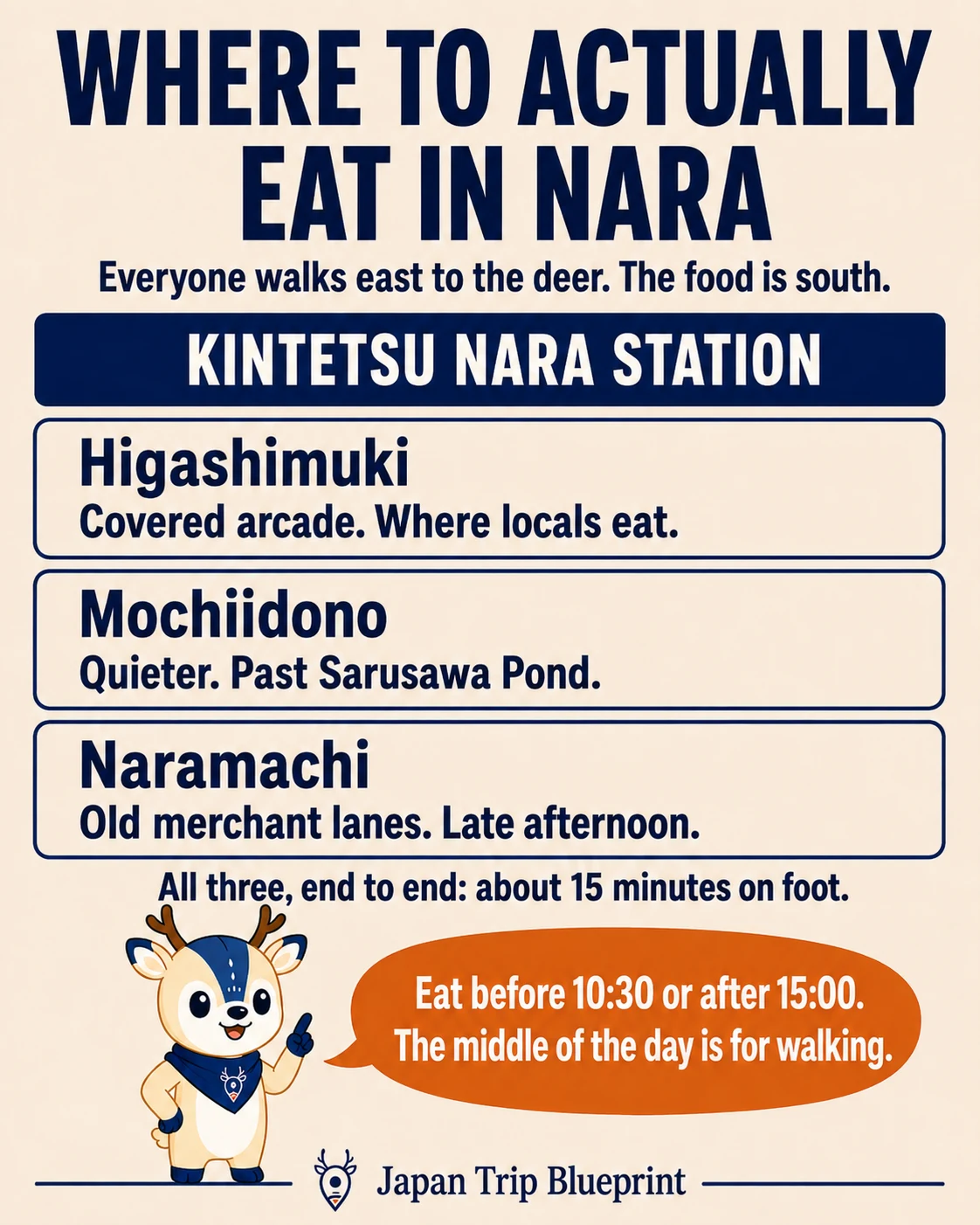
Higashimuki Shopping Street starts directly at Kintetsu Nara Station. It is a covered arcade running south, which matters more than it sounds: it is the one place you can eat comfortably in rain or in August heat. This is also where the everyday restaurants are, including the chains and ramen shops that locals use rather than tourists.
Mochiidono Center Street picks up where Higashimuki ends, running further south past Sarusawa Pond. It is a little quieter and a little more local.
Naramachi is the old merchant district beyond that — narrow streets, machiya townhouses, small cafes and restaurants in converted buildings. This is the one to walk in the late afternoon and early evening, when the day-trippers have gone and the light is good.
The practical point: if you are standing in Nara Park at 5pm wondering whether there is dinner, walk back west through Higashimuki. Everything is within about ten minutes of the station.
Ao’s tip: The biggest food mistake in Nara is a timing mistake, not a location one. Between about 10:30 and 15:00 the park is at its most crowded and the places nearest to it are at their worst. Eat early or eat late, and use the middle of the day for walking instead. This is worse at weekends, on public holidays and during long holiday periods.
The Sake Part Nobody Tells You
Nara is where refined sake began.
Shoryaku-ji, a temple in the hills east of Nara City, is said to be the birthplace of seishu — clear, refined sake, as opposed to the cloudy stuff that came before it. The brewing techniques developed at temples like this one are the ancestors of essentially every bottle you will drink in Japan. There are 28 sake breweries in Nara Prefecture today.
I mention this because visitors research Kyoto’s tea and Osaka’s street food and then arrive in Nara with no idea that they are standing in the origin point of the national drink. If you drink at all, order Nara sake here specifically, and say where you are — most places will point you at something local.
If you do not drink, this is still worth knowing, because it explains the narazuke above. Sake lees are a by-product of brewing. A town that brewed a great deal of sake had a great deal of lees to use up, and pickling was the answer.
Nara at the Top End: What the MICHELIN Guide Actually Says
The 2026 MICHELIN Guide Nara edition lists 78 restaurants:
| Category | Count |
|---|---|
| Two stars | 4 |
| One star | 18 (one new) |
| Bib Gourmand | 11 |
| Selected | 45 (seven new) |
| Green Star | 7 |
The four two-star restaurants — akordu, Oryori Hanagaki, Tsukumo and NARA NIKON — have held that rating for five consecutive years.
Two things are worth drawing out of that table.
First, the Bib Gourmand category. Those are 11 restaurants recognised specifically for good food at a moderate price. If you want the interesting end of Nara without a serious bill, that is the list to look at, not the starred one.
Second, eight new entries this year. Nara’s restaurant scene is still expanding. New places are opening while most visitors still think of this as somewhere you leave at 4pm.
If you want a starred restaurant, book well ahead — these are small rooms, and Nara does not have the volume of seats that Kyoto or Osaka does.
How to Order When There Is No English Menu
Nara has fewer English menus than Kyoto or Osaka. That is a direct consequence of the day-trip pattern: a restaurant whose customers leave before dinner never had much reason to print one.
It is not a real obstacle. Most places have photographs, plastic models in the window, or a ticket machine at the door. Pointing is normal and nobody minds.
If you want the specifics — the ticket machines, the phrases that actually help, what to do when you are handed something you did not expect — we covered it in how to order food in Japan.
One Nara-specific note: smaller places here close earlier than you would expect, and some shut between lunch and dinner. If you have a particular restaurant in mind, check its hours on the day.
Where to Stay If You Are Here for the Food
If you have read this far, the day-trip maths has probably already broken down for you. Cha-gayu is a breakfast. Naramachi is best in the evening. Starred restaurants take dinner bookings. None of that survives a 4pm train back to Kyoto.
Ao’s shortcut: If food is what brought you here, stay in front of Kintetsu Nara Station rather than out by the park. Everything in this guide is within about ten minutes’ walk of that station, and you can go back to your room between lunch and dinner instead of carrying a bag around all day.
IROHA GRAND HOTEL Kintetsu Nara Ekimae sits about two minutes from the station, which puts Higashimuki Shopping Street directly outside the door.
For the full picture — including what has opened here recently, and the argument for why Nara stopped being a day trip at all — see the best hotels in Nara.
Fitting Nara Food Into an Actual Trip
If you only have a day. Eat kakinoha-zushi early, watch the mochi pounding on your way through Higashimuki, and get to a proper meal before 15:00 or after 17:00. Do not try to eat next to the deer at midday. Our Nara day trip route from Osaka or Kyoto sets the walking order that makes this work.
If you are coming from Kyoto specifically. The train is short enough that timing is the only real constraint. The Kyoto to Nara day trip guide covers which line to take and when to leave.
If you are still deciding where to base yourself. Food is a legitimate reason to pick one Kansai city over another, and the three are genuinely different at 9pm. Where to stay in Kansai compares them properly.
If you want the contrast. Nara and Osaka are opposite ends of Japanese eating — one quiet and old, one loud and immediate. Read what to eat in Osaka after this one and the difference is obvious.
Nara Food FAQ
What food is Nara famous for?
Kakinoha-zushi (persimmon leaf sushi), narazuke (pickles cured in sake lees), miwa somen noodles, kuzumochi, yomogi mochi and cha-gayu (tea rice porridge). Nara is also the historical birthplace of refined sake.
Is there anywhere to eat dinner in Nara?
Yes. This is the most persistent myth about the city. The streets around Kintetsu Nara Station have ordinary restaurants and ramen shops that residents use, and the 2026 MICHELIN Guide lists 78 restaurants in Nara.
Can I eat while walking around Nara Park?
Be careful. The deer are wild animals, and visible food — including a bag with food in it — will get you surrounded quickly. Eat before you enter the park area, or after you leave it.
Is Nara food expensive?
It spans the full range, from arcade ramen up to two-star counters. The 11 Bib Gourmand entries in the MICHELIN Guide are the category to look at if you want something interesting without a serious bill.
Do I need to book restaurants in Nara?
For anything starred, yes, and well ahead — the rooms are small. For everyday places around the station, no.
What should I eat if I only have one hour?
Kakinoha-zushi. It is portable, it keeps, and it is the one Nara food with a story you will remember.
Is Nara or Kyoto better for food?
They are different rather than ranked. Kyoto has more restaurants, more English menus and more competition for seats. Nara is quieter, older, and easier to get into without booking. If you are doing both, read what to eat in Kyoto alongside this.
When is the worst time to eat in Nara?
Roughly 10:30 to 15:00, when the day-trip crowd peaks. It is worse at weekends, on public holidays and during long holiday periods.
Planning your first Japan trip? Get the free Japan Starter Guide →